|
In
Minister of Education and Another v Wynkwart NO 2004
(3) SA 577 (C)
 R, a
nine-and-a-half-year-old minor at the time of the accident, was seriously
injured when he fell off an unused but locked gate at his school. Contrary
to repeated warnings not to climb over the fence and gates R did so, instead
of using the other available gates. The trial court found in favour of R’s
father who was representing him, saying that the school management had
failed to take reasonable steps to ensure that R, like all his peers, left
the school through the correct exit gate. On appeal to the full bench the
court reversed the decision of the trial court on the basis that the
perimeter fence and gates in place were reasonable safety measures. In
addition thereto pupils were regularly warned of the dangers of climbing
over the school gates and fences. Furthermore, there was in use a properly
considered system of teacher, and even scholar, supervision to manage the
daily egress of pupils simultaneously from other gates.

Indemnities
again. Subscribers refresh your memories by
clicking here.
Koen v Storms River Adventures CC July 2003.
The plaintiff sued the
defendant for damages for injuries sustained by her as a result of an accident
while on a river tubing expedition organised by defendant. Prior to the outing,
the plaintiff was required to sign an indemnity form which indemnified defendant
against any injury or death which resulted from its negligence. The accident in
question occurred while plaintiff was being driven by an employee of the
defendant in one of the defendant's vehicles. The Court found that the
evidence established that the vehicle's braking system was not entirely safe at
the time. The defendant was aware of this. In signing the indemnity form, the
plaintiff had accepted the risks associated with the adventure trips offered by
the defendant. The
defendant relied on the agreement of indemnity entered into by the plaintiff and
itself prior to embarking on the venture. The relevant clause of the agreement
reads as follows:
"not to claim from and undertake not to
take legal action against and to indemnify, hold harmless and absolve
StormsRiver Adventures, its owners, members, guides, organisers, servants,
helpers and agents from any or all claims and or liability in connection with
loss or damage to any property or injury to myself or even my death arising from
negligence of the above parties or from any cause whatsoever in the course of
any tours and/or transport organized by StormsRiver Adventures in which I
partake."
Subscribers
click here
to ascertain whether the indemnity
was upheld.  Case
reported in August 2004.

Subscribers click on
Ras NO v Senekal & another [2003] (T).
Plaintiff was the curator
ad litem for a person who had leased a flat owned by the first defendant.
The lessee was found lying in his bath, in a coma. According to the plaintiff,
the lessee was poisoned by gas in a gas leak in the flat. It was alleged that
first defendant was liable for the ensuing damages, because he had a duty to
ensure that the flat was properly maintained. The court found that the issues
for determination were whether the lessee had sustained brain injuries as a
result of gas poisoning, whether such poisoning was caused by first defendant's
negligence, and whether there was any contributory negligence on the lessee's
part. (Case reported in August 2004).
What is the impact of contributory negligence in
a criminal OHS Act trial?
Nothing. Only the negligence of the accused is considered
although contributory negligence can impact upon sentence. (Mitigate). The other
party may be charged separately for a negligence offence in terms of the OHS Act
as often happens when an employer is charged with a
section 8
contravention while an employee is charged with contravening
section 14
emanating from the same incident.

Subscribers
click here
for
Niemann v
African Oxygen Ltd July 2004 for
a recent case involving a motor vehicle collision and contributory negligence.
Aboobacar & another v Greater Johannesburg Metropolitan
Council [2003] JOL 11855 (W).
As plaintiffs in the High court, the appellants
had claimed compensation from the respondent for damages suffered as a result of
a municipal water pipe bursting and the consequent flooding of the appellant's
home which caused extensive damage. The court held that the only issue
for decision was whether or not the evidence established the respondent's
negligence. Although municipalities enjoy a measure of immunity against
delictual actions, such immunity is not absolute. The court found that the
municipal supply of water is potentially hazardous and should be operated and
controlled with skill, circumspection and care. Where a person is in control of
dangerous objects, injury may more easily result if reasonable care is not
taken. Thus the reasonable man test is in such circumstances modified to form a
reasonable expert test. Having regard to the evidence, the court found that the
appellant had established, on a balance of probabilities, that there had been
negligence on the part of the respondent. The appeal was upheld.
The decision
in
Hamilton v Minister of Safety and Security [2003] 1 All SA 678 (C)
had far-reaching implications as far as the potential liability of the Minister
of Safety and Security for the neglect of police officers to apply their minds
to their job were concerned. The case involved the issuing of a firearm license
to a mentally disturbed person who then shot another person during an
altercation at a parking lot. The court found that the police had failed in
their duty of care and were thus liable to
compensate the party who was shot and
paralysed. See
Minister of Safety & Security v Hamilton [2003]
JOL 11632 (SCA).
Click here
for summary.
Why is this and
the
Carmichele case
important? Because the it shows that the State can be held liable if it
fails in its duty of care. In terms of section 12(1) of the Bill of Rights to
the Constitution the State guarantees everyone the right to freedom and security
of person. Will the State (Ministry of Labour) be sued for failing in their duty
of care in the Lenasia factory fire? The precedent has been set.
Click here
for more. And what about the person who was paralysed when the marquee collapsed
on International Women's day?
Click here
for more. Section 24
of the Bill of Rights guarantees everyone the
right
to an
environment that is not harmful to their health or well-being.
When is a medical practitioner negligent? In
Roos v Sinclair [2004] 1 All SA 299 (NC)
the
court upheld an appeal by a medical practitioner that he failed in his duty of
care by failing to ensure that a father properly administered medication to his
child.
Click here for summary. (Electronic Law Report
not yet available).
Grootbroom v Graaff-Reinet Municipality [2001] JOL 7975
(E)
Grootbroom sued the municipality
for damages after his minor son sustained an electric shock and had to have both
his arms amputated when he climbed an electric transformer installation and came
into contact with high voltage electricity. The court had to determine whether
the defendant was liable to plaintiff for the consequences of the incident. The
plaintiff alleged negligence on the part of the defendant. The court held that
it was common cause that the incident occurred on property under defendant's
control. The test for negligence is the well-known diligens paterfamilias
test. It had to be established whether the defendant's conduct fell short of
that of the reasonable person. It was clear to the court that the defendant was
carrying out a very dangerous undertaking. It could have taken extra precautions
which were regarded as reasonable and inexpensive. The court therefore found
that the defendant was liable for plaintiff's damages.
Vicarious liability of employer for delict committed by employee.
In
Van Drimmelen and Partners v Gowar and Others [2004] 1 All
SA 175 (SCA)
the court held that the employer was not liable for a delict committed
(causing personal injuries suffered in a motor vehicle collision) after work
when the employee was going home.
More...
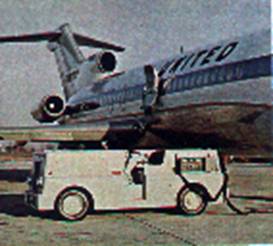
Road
Accident Fund v Vogel.
February 2004 SCA. An accident at an airport. A
Mobile ground power unit providing electric power to stationary
aircraft at airports smashes into an aircraft. Is it a motor vehicle as defined
in section 1 of Road Accident Fund Act 56 of 1996?
Click here for the answer.

RAF appeal dismissed. News24 of 18 May
2004. 'The widow of a taxi passenger who died in an accident involving a special
haul truck can sue the Road Accident Fund (RAF) in terms of a Supreme Court of
Appeal ruling this week. A summary of the judgment released on Tuesday said the
court found that the truck, a Caterpillar 769, was a motor vehicle as defined by
the Road Accident Fund Act 56 of 1998. The RAF brought the appeal, contending
the truck was meant for use on specially prepared roads only. It was not
designed to travel on public roads. This meant the widow of the accident victim
was not entitled to claim damages from the fund, the RAF argued. The appeal was
dismissed with costs'.
Click here for
RAF v Mbendera & others[2004] JOL
12680 (SCA)
Click here
for Road Accident Fund Website.
RAF 'technically bankrupt'.
News24 'The Road Accident Fund (RAF) is technically bankrupt and is operating
on a technical deficit of about R16.6bn says forensic investigator Ignatius Leopoldus Rautenbach. In a statement submitted to Pretoria regional court,
Rautenbach claims the fund became a "cash cow" for fraud syndicates'.

Carmichele is still waiting for retribution.
The Star of 27 April 2004. 'Six months after winning her ground-breaking court
case, photographer Alix Carmichele has not yet been paid by the state for the
psychological and physical damage suffered at the hands of a rapist released on
bail. Carmichele won the case against the ministries of Justice and of Safety
and Security in the Supreme Court of Appeal in Bloemfontein late last year'.
More....
Joburg doctor sued for R20-million.
IOL 'A former SABC make-up artist is suing a Johannesburg
surgeon for R20-million after an "outdated technique" was used to operate on
her, leaving her unable to conceive. Ilze van den Heever, 30, a hair-stylist and
former freelance SABC make-up artist, is suing Dr RW White, who has accepted 90
percent liability. He conceded that he should not have operated on Van den
Heever. Now the Pretoria High Court has to determine damages payable to the
woman. Several experts will testify in the coming weeks about the type of
medication and treatment she will require. Van den Heever's husband Theo, a
partner at Deloitte, on Monday testified that the only way his wife can still
have a semi-normal life is by injecting herself twice a day with medication
costing R13 300 a month.
The more than
R20,8-million claim includes R11-million for the medication'.
"Had he told me of the risks involved
(in the operation) I would not have consented to it," she stated.
Could these 'defences' apply?
Indemnities? Volenti non fit iniuria? (Voluntarily undertaking risk). See
Pfister
v Murray [2003] JOL 11272 (T)
Neither 'defences' apply in
criminal law e.g. the OHS or MHS Acts.
Ntapane v Minister of Safety & Security [2003] JOL 11986
(Tk).
Plaintiff had sued the Minster of Safety &
Security for damages for loss of support. The plaintiff's breadwinner was shot
dead through a window by a policeman who was illegally in possession of his
motor vehicle. Was the policeman acting within the scope of his authority and in
the course of his employment thus triggering vicarious liability for the
minister? At the end of plaintiff's case, the defendant applied for absolution
from the instance. The question was whether, at the close of the plaintiff's
case, there was evidence upon which a reasonable man might find for the
plaintiff. The plaintiff had sued the defendant on the basis that the person who
had shot the deceased was acting in the course and scope of his employment with
defendant at the time of the shooting. This attempt to impute vicarious
liability on the the Minister failed as no prima facie case was
established against the defendant. Absolution was granted. The same principles
apply when someone is injured or killed at the workplace by an employee. (A
servant of the company).
|
